
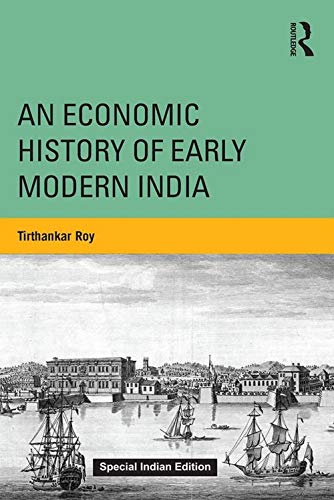
An Economic Histroy of Early Modern India. / Tirthankar Roy.
Material type: TextPublisher number: International Book Distributors | : Flat No. 17, Prakash Apartment, 5 Ansari Road, Daryaganj, New Delhi.Publication details: New York Routledge ,2013.Description: x,174p. :24cmISBN:
- 9781138566972
- 330 ROY
| Item type | Current library | Call number | Status | Barcode | |
|---|---|---|---|---|---|
 Books |
SNU LIBRARY | 330 ROY (Browse shelf(Opens below)) | Available | 25227 |
Introduction--
Formation of New States--
Consequences of state formation--
The agrarian order--
Conditions of business--
Towns---
Levels of Living--
Conclusion--
The death of the Mughal emperor Aurangzeb in 1707 until the annexation of Maratha territories by the British East India Company in 1818 was a period of transition for the economy of India. This book focuses on these transitions, and shows how a study of this period of Indian history contributes to a deeper understanding of the long-run patterns of economic change in India.
Momentous changes occurred in business and politics in India during the eighteenth century - the expansion of trade with Europe and the collapse of the Mughal Empire, resulting in the formation of a number of independent states. This book analyses how these two forces were interrelated, and how they went on to change livelihoods and material wellbeing in the region. Using detailed studies of markets, institutions, rural and urban livelihoods, and the standard of living, it develops a new perspective on the history of eighteenth century India, one that places business at the centre, rather than the transition to colonial rule.
This book is the first systematic account of the economic history of early modern India, and an essential reference for students and scholars of Economics and South Asian History.
There are no comments on this title.
