
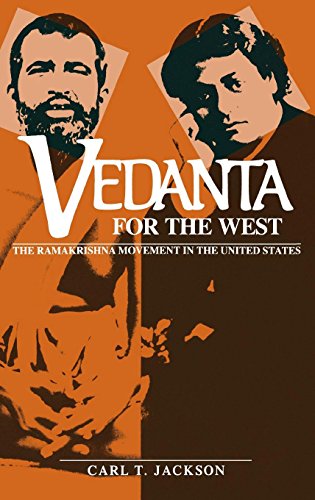
Vedanta for the West : the Ramakrishna movement in the United States /Carl T Jackson
Material type: TextPublisher number: Atlantic Publishers & Distributors (P)LTD. | ;7/22,Anasri Road, Daryaganj,New Delhi-110002Series: Religion in North AmericaPublication details: Bloomington : Indiana University Press , ©1994.Description: xiv, 185 pages ; 25 cmISBN:
- 9780253330987
- 294.5550 JAC
| Item type | Current library | Call number | Status | Barcode | |
|---|---|---|---|---|---|
 Books |
SNU LIBRARY | 294.5550 JAC (Browse shelf(Opens below)) | Not For Loan | 25817 |
Foreword / Catherine L. Albanese and Stephen J. Stein --
1. The Nineteenth-Century Background --
2. The Founders: Ramakrishna and Vivekananda --
3. Trials of Survival: The Organization of an American Movement --
4. Vedanta for Americans: The Teachings of the Ramakrishna Movement --
5. The Appeals of Vedanta --
6. The Movement since the 1920s --
7. The Ramakrishna Movement in History: Past, Present, and Future --
Appendix: Vedanta Centers.
The Ramakrishna movement was the very first and in many ways the most important Asian religious group to appear in America. Founded on the teachings of the nineteenth-century Bengali visionary Sri Ramakrishna, the movement was brought to the United States in 1893 by Swami Vivekananda, a disciple of Ramakrishna. Although its membership is small, the movement has exercised a significant influence in the last hundred years, promoting Hindu reform and revival in India and increasing public awareness of Hinduism through its Vedanta societies in the United States and Europe. An important history of the oldest form of Hinduism in America, this book sheds new light on the progress and adaptation of Eastern spirituality in the West. Carl T. Jackson begins his account with a brief examination of conditions in nineteenth-century India and the United States that explain the sudden appearance of the Ramakrishna movement in the West. He details the origins and teachings of the movement, Swami Vivekananda's seminal role as founder and organizer of Western "work," and the subsequent history of the American mission. Jackson also discusses the movement's American teachings and explains the attraction of Vedanta for Americans. Although conservative in its presentation of Hinduism, the Ramakrishna movement has freely embraced Western methods. As Jackson shows, it is the "middle way" in American Hinduism, taking a path between devotional forms such as the International Society for Krishna Consciousness (Hare Krishna) and meditation ones such as the Self-Realization Fellowship and Transcendental Meditation.
There are no comments on this title.
