
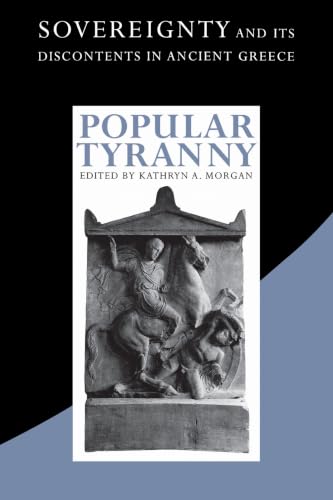
Popular tyranny :sovereignty and its discontents in ancient Greece / Kathryn A Morgan
Material type: TextPublisher number: :International Book Distributors | :Flat No 14, Prakash Apartment 5 Ansari Road Darya Ganj New DelhiPublication details: Austin : University of Texas Press, ©2003.Description: xxvii, 324p 24cmISBN:
- 9780292722316
- 320.9380 MOR
| Item type | Current library | Call number | Status | Barcode | |
|---|---|---|---|---|---|
 Books |
SNU LIBRARY | 320.9380 MOR (Browse shelf(Opens below)) | Not For Loan | 26332 |
Imaginary kings: alternatives to monarchy in early Greece / Sarah Morris --
Form and content: the question of tyranny in Herodotus / Carolyn Dewald --
Stick and glue: the function of tyranny in fifth-century Athenian democracy / Kurt A. Raaflaub --
Tragic tyranny / Richard Seaford --
Dēmos tyrannos: wealth, power, and economic patronage / Lisa Kallet --
Demos, demagogue, tyrant in Attic old comedy / Jeffrey Henderson --
The tyranny of audience in Plato and Isocrates / Kathryn A. Morgan --
Tyrant killing as therapeutic Stasis: a political debate in images and texts / Josiah Ober --
Changing the discourse / Robin Osborne.
The nature of authority and rulership was a central concern in ancient Greece, where the figure of the king or tyrant and the sovereignty associated with him remained a powerful focus of political and philosophical debate even as Classical Athens developed the world's first democracy. This collection of essays examines the extraordinary role that the concept of tyranny played in the cultural and political imagination of Archaic and Classical Greece through the interdisciplinary perspectives provided by internationally known archaeologists, literary critics, and historians. The book ranges historically from the Bronze and early Iron Age to the political theorists and commentators of the middle of the fourth century B.C. and generically across tragedy, comedy, historiography, and philosophy. While offering individual and sometimes differing perspectives, the essays tackle several common themes: the construction of authority and of constitutional models, the importance of religion and ritual, the crucial role of wealth, and the autonomy of the individual. Moreover, the essays with an Athenian focus shed new light on the vexed question of whether it was possible for Athenians to think of themselves as tyrannical in any way. As a whole, the collection presents a nuanced survey of how competing ideologies and desires, operating through the complex associations of the image of tyranny, struggled for predominance in ancient cities and their citizens
There are no comments on this title.
