
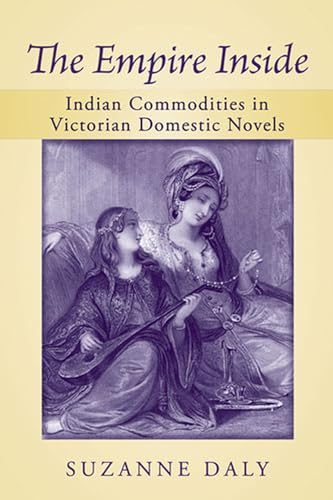
The empire inside : Indian commodities in Victorian domestic novels /Suzanne Daly
Material type: TextPublisher number: Technical Bureau Private Limited | ;E-261,Shastri Nagar,Delhi-110052Publication details: Ann Arbor : University of Michigan Press , 2011.Description: 167 pages ; 24 cmISBN:
- 9780472051342
- 823.8093 DAL
| Item type | Current library | Call number | Status | Barcode | |
|---|---|---|---|---|---|
 Books |
SNU LIBRARY | 823.8093 DAL (Browse shelf(Opens below)) | Available | 27548 |
Introduction: colonial commodities and the naturalization of empire --
The private life of things: Kashmir shawls --
Mechanization, free trade, and imperialism: cotton --
Plunder as property: diamonds --
Tea and the mode of (literary) production --
Imperial imports at the fin de siecle.
By the early nineteenth century, imperial commodities had become commonplace in middle-class English homes. Such Indian goods as tea, textiles, and gemstones led double lives, functioning at once as exotic foreign artifacts and as markers of proper Englishness. This book reveals how Indian imports encapsulated new ideas about both the home and the world in Victorian literature and culture. In novels by Charlotte Bronte, Charles Dickens, and Anthony Trollope, the regularity with which Indian commodities appear bespeaks their burgeoning importance both ideologically and commercially. Such domestic details as the drinking of tea and the giving of shawls as gifts point us toward suppressed connections between the feminized realm of private life and the militarized realm of foreign commerce. Tracing the history of Indian imports yields a record of the struggles for territory and political power that marked the coming-into-being of British India; reading the novels of the period for the ways in which they infuse meaning into these imports demonstrates how imperialism was written into the fabric of everyday life in nineteenth-century England. Situated at the intersection of Victorian studies, material cultural studies, gender studies, and British Empire studies, this book is written for academics, graduate students, and advanced undergraduates in all of these fields.
There are no comments on this title.
