
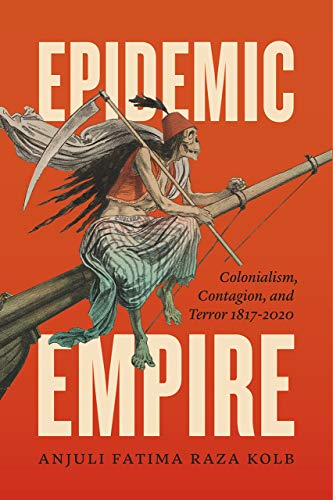
Epidemic empire : colonialism, contagion, and terror, 1817-2020. / Anjuli Fatima Raza Kolb.
Material type: TextPublisher number: : International Book Distributors | : Flat no. 17, Prakash Apartment, 4405/2, 5 Ansari Road, Daryaganj, New Delhi.Publication details: , Chicago : University of Chicago Press , 2021.Description: 396 pages : illustrations :24cmISBN:
- 9780226739359
- 303.625 RAZ
| Item type | Current library | Call number | Status | Barcode | |
|---|---|---|---|---|---|
 Books |
SNU LIBRARY | 303.625 RAZ (Browse shelf(Opens below)) | Available | 29289 |
Introduction: "Islam," Terrorism, and the Epidemic Imaginary
Part One: The Disease Poetics of Empire
Chapter 1: Great Games
Chapter 2: The Blue Plague
Chapter 3: Circulatory Logic
Part Two: The Body Allegorical in French Algeria
Chapter 4: The Brown Plague
Chapter 5: Algeria Ungowned
Part Three: Viral Diaspora and Global Security
Chapter 6: Selfistan
Chapter 7: Cures from Within
Terrorism is a cancer, an infection, an epidemic, a plague. For more than a century, this metaphor has figured insurgent violence as contagion in order to contain its political energies. In Epidemic Empire, Anjuli Fatima Raza Kolb shows that this trope began in responses to the Indian Mutiny of 1857 and tracks its tenacious hold through 9/11 and beyond. The result is the first book-length study to approach the global War on Terror from a postcolonial literary perspective. Raza Kolb assembles a diverse archive from colonial India, imperial Britain, French and independent Algeria, the postcolonial Islamic diaspora, and the neoimperial United States. Anchoring her book are studies of four major writers in the colonial-postcolonial canon: Rudyard Kipling, Bram Stoker, Albert Camus, and Salman Rushdie. Across these sources, she reveals the tendency to imagine anticolonial rebellion, and Muslim insurgency specifically, as a virulent form of social contagion. Exposing the long history of this broken but persistent narrative, Epidemic Empire is a major contribution to the rhetorical history of our present moment.
There are no comments on this title.
