
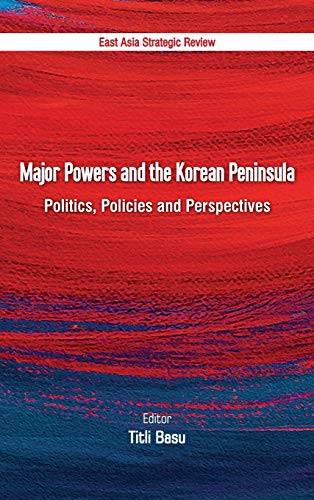
Major powers and the Korean peninsula : politics, policies and perspectives. /Titli Basu.
Material type: TextPublisher number: : Donated by (IRGS Dept.) Dr. Jabin Thomas | : SNIOEPublication details: , New Delhi : KW Publishers Pvt Ltd , 2019.Description: xvii, 371p. : 24cmISBN:
- 9789389137156
- 320.519 BAS
| Item type | Current library | Call number | Status | Barcode | |
|---|---|---|---|---|---|
 Books |
SNU LIBRARY | 320.519 BAS (Browse shelf(Opens below)) | Available | G3740 |
The Korean Peninsula, which constitutes one of the strategic pivots of Northeast Asian security, has remained a contested theatre for major powers. Denuclearisation of the Peninsula is unfolding as one of the most defining challenges in shaping regional security. The end state in the Peninsula and how it is to be realised is debated amongst the stakeholders. This book aims to situate some of the critical issues in the Korean theatre within the competing geopolitical interests, strategic choices and policy debates among the major powers. This volume is an endeavour to bring together leading Indian experts including former Indian ambassadors to the Republic of Korea, senior members from the defence and strategic community to analyse the developing situation in the Korean Peninsula.
The Korean Peninsula has remained a contested theatre for the major powers. Brutal wars have been fought involving imperial Japan, Czarist Russia, the Union of the Soviet Socialist Republics (USSR), Qing China, the People's Republic of China, and the United States (US) which left the Peninsula conquered, colonised, and divided, starting with Chosun (Yi) Korea from 1392-1910 to colonial Korea from 1910-45 to divided Korea since 1945.1 Subsequently, the Korean War from 1950-53 defined the character of the Cold War in Northeast Asia. The strategic choices in the Korean theatre have been influenced by the competing geopolitical interests of regional stakeholders. In the post-Cold War era, the Peninsula remained a key variable in shaping the Northeast Asian security architecture since the Democratic People's Republic of Korea or North Korea continued to employ the strategic use of nuclear brinksmanship.
There are no comments on this title.
