
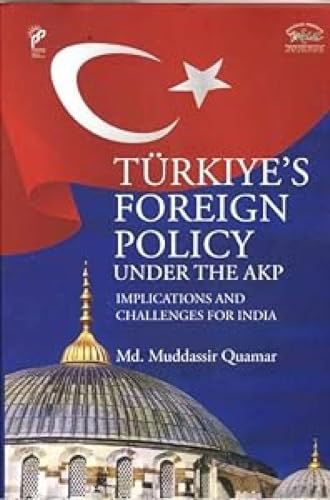
Turkiye`s Foreign Policy Under the AKP : Implications and Challenges for India. /Muddassir Quamar.
Material type: TextPublisher number: : Donated by (IRGS Dept.) Dr. Jabin Thomas | : SNIOEPublication details: , New Delhi : Pentagone Press , 2024.Description: xii,176p. : 24cmISBN:
- 9788195189427
- 346.56 QUA
| Item type | Current library | Call number | Status | Barcode | |
|---|---|---|---|---|---|
 Books |
SNU LIBRARY | 346.56 QUA (Browse shelf(Opens below)) | Available | G3757 |
During the first two decades of the twenty-first century, besides the structural factors namely geography, history, politics, international system and the world order, five conjunctural factors dominated Turkish foreign policy behaviour and conduct. These include the Strategic Depth (Stratejik Derinlik) doctrine with ‘zero-problem’ with neighbours embedded in it followed by the Blue Homeland (Mavi Vatan) doctrine focused on enhancing Türkiye’s maritime presence in its immediate neighbourhood and the periphery. Thirdly, and arguably the most important, is the personality of Recep Tayyip Erdogan who as a dominating figure in contemporary Turkish politics has shaped not only the political discourse but foreign policy praxis. Erdogan’s personalised style of interventions has undoubtedly had a profound impact on Ankara’s interactions and engagements with the wider world. Finally, pan-Islamism and neo-Ottomanism are two important drivers in Turkish foreign policy and were visible notably in the Middle East and North Africa region and came into prominence in the wake of the Arab Spring uprisings. In this context, it is pertinent to ask what are Turkish foreign policy ambitions and how do these impact India? Given that Ankara has expanded its presence, or at least is striving to expand it, in the geographically contiguous Southwest Asia region that connects India to the Middle East.
There are no comments on this title.
