
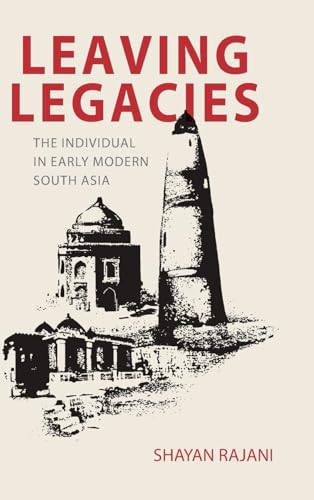
Leaving Legacies : The Individual in Early Modern South Asia. / Shayan Rajani.
Material type: TextPublisher number: : International Book Distributors | : Flat No. 17, Prakash Apartment, 5, Ansari Road, Daryaganj, New DelhiPublication details: , New York : Cambridge University Press , 2024.Description: viii, 298p. : 24cmISBN:
- 9781009509510
- 954.025 RAJ
| Item type | Current library | Call number | Status | Barcode | |
|---|---|---|---|---|---|
 Books |
SNU LIBRARY | 954.025 RAJ (Browse shelf(Opens below)) | Not For Loan | 31430 |
Leaving Legacies is a fresh account of the individual in early modern South Asia. A gendered practice carried out by men, leaving legacies involved assembling three kinds of material traces: monuments, books, and sons. Men laid claim to individual distinction within an ethics of remembering worthy individuals by joining their traces with those of men past and reworking older legacies. Their legacies joined their present to the past and future, while also drawing women and non-elite men into a hierarchical order centered upon the individual during Mughal rule and after. This book shows that a concern for the individual self was not an exclusively western phenomenon. Rather, the practice of leaving individual legacies was a crucial means for the production and reproduction of empire, family, and social order in South Asia.
There are no comments on this title.
