
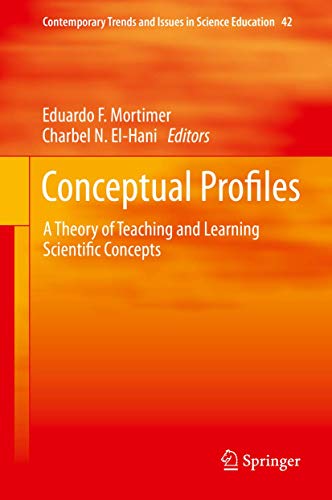
Conceptual Profiles : A Theory of Teaching and Learning Scientific Concepts / edited by Eduardo F. Mortimer and Charbel Niño El-Hani.
Material type: TextPublication details: Dordrecht : Springer , 2014.Edition: First editionDescription: xvii, 330 p. : illustrations ; 24 cmISBN:
- 9789048192458
- 507.1 MOR 23
| Item type | Current library | Call number | Status | Notes | Barcode | |
|---|---|---|---|---|---|---|
| VC Office Books | SNU LIBRARY | 507.1 MOR (Browse shelf(Opens below)) | Not For Loan | Books Received from VC office | VC186 |
Conceptual Profiles: A Theory of Teaching and Learning Scientific Concepts presents an influential theoretical framework for understanding how students learn scientific concepts. Edited by Eduardo F. Mortimer and Charbel Niño El-Hani, the book argues that learners do not simply replace incorrect ideas with correct scientific ones. Instead, they develop multiple conceptual profiles, allowing them to use different ways of thinking depending on the context. This approach extends traditional theories of conceptual change by recognizing the coexistence of scientific, everyday, and culturally informed meanings. The volume combines theoretical discussions with empirical research from science classrooms. It explains the philosophical and psychological foundations of Conceptual Profile Theory, drawing on the work of Lev Vygotsky, situated cognition, and pragmatist philosophy. The contributors demonstrate how the theory can be applied to core scientific concepts such as molecules, life, biological adaptation, entropy, heat, temperature, and death, illustrating how students' ideas evolve through instruction and social interaction. Designed primarily for researchers and teacher educators, the book provides practical implications for curriculum development, classroom instruction, and teacher preparation. It encourages educators to acknowledge the diversity of students' conceptual understandings and to design learning experiences that help learners move flexibly between everyday and scientific modes of thinking. The work is an important resource for graduate students and scholars in science education, educational psychology, curriculum studies, and STEM education.
There are no comments on this title.
