
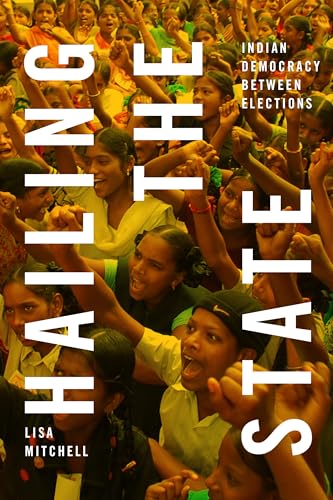
Hailing the State : Indian Democracy between Elections. / Lisa Mitchell.
Material type: TextPublisher number: : Raghav Books Pvt. Ltd. | : B-2/25, 1st Floor, Arun house, Ansari Road, Darya ganj, New DelhiPublication details: , London : Duke University Press , 2023.Description: xviii, 300p. : 24cmISBN:
- 9781478018766
- 324 MIT
| Item type | Current library | Call number | Status | Barcode | |
|---|---|---|---|---|---|
 Books |
SNU LIBRARY | 324 MIT (Browse shelf(Opens below)) | Available | 31764 |
In Hailing the State, Lisa Mitchell explores the methods of collective assembly that people in India use to hold elected officials and government administrators accountable, demand inclusion in decision making, and stage informal referendums. Mitchell traces the colonial and postcolonial lineages of collective forms of assembly, in which―rather than rejecting state authority―participants mobilize with expectations that officials will uphold the law and fulfill electoral promises. She shows how assembly, which ranges from sit-ins, hunger strikes, and demands for meetings with officials to massive general strikes and road and rail blockades, is fundamental to the functioning of democracy in India. These techniques are particularly useful for historically marginalized groups and others whose voices may not be easily heard. Moving beyond an exclusive focus on electoral processes, Mitchell argues that to understand democracy―both in India and beyond―we must also pay attention to what occurs between elections, thereby revising understanding of what is possible for democratic action around the world.
There are no comments on this title.
