
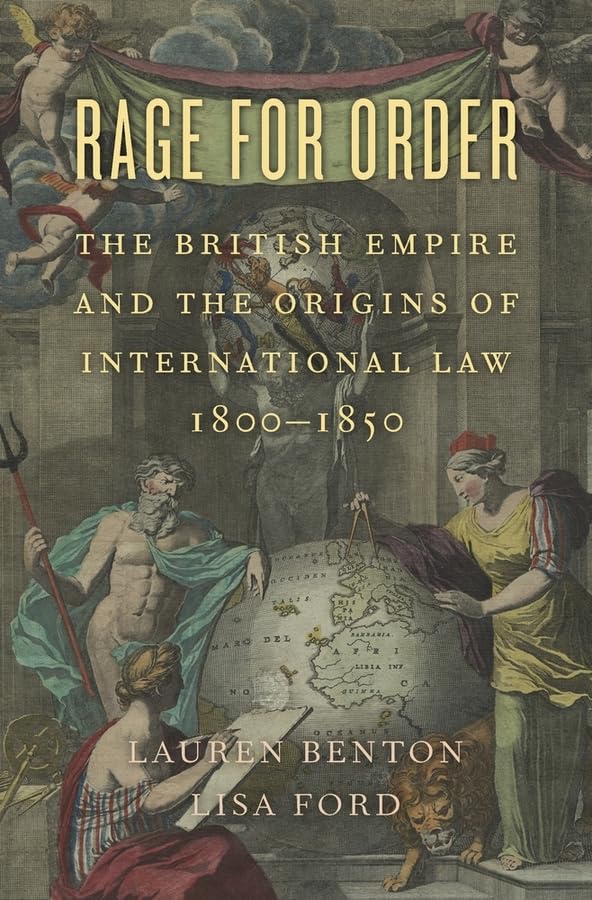
Rage for order : the British Empire and the origins of international law, 1800-1850 /Lauren A Benton
Material type: TextPublisher number: International Book Distributors | ;Flat No.17,Prakash Apartments,5 Ansari Road,Daryaganj New Delhi-110002Publication details: Cambridge, Massachusetts : Harvard University Press , 2016.Description: 282 pages : illustrations ; 25 cmISBN:
- 9780674737464
- 342.11241 BEN
| Item type | Current library | Call number | Status | Barcode | |
|---|---|---|---|---|---|
 Books |
SNU LIBRARY | 342.11241 BEN (Browse shelf(Opens below)) | Not For Loan | 25753 |
A global empire of law --
Controlling despotic dominions --
The commissioner's world --
The promise of protection --
Ordering the oceans --
An empire of states --
A great disorder.
Rage for Order surveys the sprawling, often frenetic attempt to redesign law in the British Empire. Across the world in the early nineteenth century, colonial officials, indigenous subjects, settlers, convicts, sailors, soldiers, and slaves participated in contests that shaped a new British imperial constitution. Contemporaries imagined that law would provide a blueprint for the empire and for global order. Within turbulent British colonies, legal reform targeted petty despots and augmented the power of the crown to intervene in the administration of justice. At the edges of empire, British campaigns to police slave trading and piracy linked imperial interests to emerging world regions and conjured new sovereignties. Rage for Order breaks new ground in the history of international law by looking beyond the treatises of jurists and instead tracing vernacular constitutional politics across the globe--in new crown colonies such as Ceylon and Trinidad, expanding settler colonies such as New South Wales and Upper Canada, established plantation colonies in the West Indies and Indian Ocean, and regions not under direct British control, from the South Atlantic to the eastern Mediterranean to the Pacific islands. By uncovering the lost history of a global empire of law, Benton and Ford reveal the way imperial structures continue to influence our understandings of world order and international law
There are no comments on this title.
