
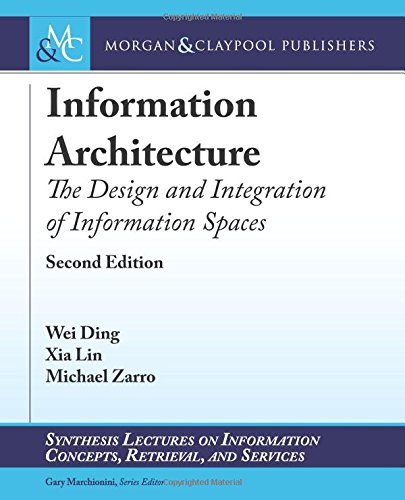
Information architecture : the design and integration of information spaces /Wei Ding; Xia Lin; Michael Zarro
Material type: TextPublisher number: Atlantic Publishers & Distributors (P)LTD. | ;7/22,Anasri Road, Daryaganj,New Delhi-110002Series: Synthesis digital library of engineering and computer science.; Synthesis lectures on information concepts, retrieval, and services, #56Publication details: San Rafael, California : Morgan & Claypool Publishers , 2017Edition: Second editionDescription: xix, 152 pages ;24 cmISBN:
- 9781627059763
- 025 DIN
| Item type | Current library | Call number | Status | Barcode | |
|---|---|---|---|---|---|
 Books |
SNU LIBRARY | 025 DIN (Browse shelf(Opens below)) | Not For Loan | 25862 |
1. Information architecture: definitions and scopes --
1.1 Definitions of information architecture --
1.1.1 Wurman's definition of information architect --
1.1.2 Rosenfield and Morville's definition --
1.1.3 Pervasive information architecture --
1.1.4 Enterprise information architecture --
1.1.5 The definition used in this book --
1.2 From web design to information architecture --
1.3 Information architecture and related disciplines --
1.4 Summary. 2. Information architecture and evolving information spaces --
2.1 From the web to integrated information spaces --
2.1.1 From foundation to integration --
2.2 Foundation --
2.3 Web1.0 --
2.4 Web2.0 --
2.4.1 Mashups --
2.4.2 Personalization and aggregation --
2.4.3 Rich internet apps --
2.4.4 Tagging and hashtags --
2.4.5 Wikis, blogs, and social media --
2.4.6 Web office applications --
2.5 Integrated generation --
2.5.1 Artificial intelligence, automated assistants --
2.5.2 Cloud --
2.5.3 Mobile --
2.5.4 Sensors and the internet of things --
2.5.5 Wearables --
2.5.6 Ubiquity and user-centered design --
2.6 Summary. 3. IA and user-centered design --
3.1 UCD background --
3.2 Include users in research and design --
3.3 Misconceptions of UCD --
3.3.1 UCD does not mean focusing only on user needs and ignoring business goals and market opportunities --
3.3.2 UCD does not mean that the design is against introducing new technologies or changes --
3.3.3 UCD does not mean that users themselves can best design for their own use --
3.4 ISO 9241 --
3.4.1 Usability --
3.5 UCD design process --
3.5.1 Front end UI design --
3.5.2 Behind the scenes: metadata and controlled vocabulary design --
3.5.3 Design deliverables --
3.5.4 UCD teams --
3.5.5 Iterative design --
3.5.6 Iterative design frameworks --
3.6 Summary. 4. IA research and evaluation --
4.1 Research --
4.1.1 Research methods --
4.1.2 Content and user research and methods --
4.1.3 User personas --
4.2 Evaluation --
4.2.1 The need for evaluation --
4.3 Research and evaluation methods --
4.3.1 Heuristic evaluation --
4.3.2 Usage statistics and log analysis --
4.3.3 Card sorting --
4.3.4 Usability testing --
4.3.5 Surveys --
4.3.6 Observation and contextual inquiry --
4.3.7 Interviews --
4.3.8 Benchmarking process --
4.4 Summary. 5. Information organization and navigation design --
5.1 Logical organization --
5.2 Semantic organization --
5.2.1 Metadata --
5.2.2 Controlled vocabularies --
5.3 Navigation systems --
5.3.1 Purpose of navigation --
5.4 Search systems --
5.5 Summary. 6. User information behavior and design implications --
6.1 Understanding user needs and information behavior --
6.2 Theories and principles about user information behavior --
6.2.1 Magic number seven --
6.2.2 Hick's law --
6.2.3 Zipf 's law: the principle of least effort --
6.2.4 Information scent theory --
6.2.5 Bounded rationality --
6.2.6 Dual process theory --
6.2.7 Paradox of choice: less is more --
6.2.8 The berry picking information behavior model --
6.2.9 Exploratory search --
6.2.10 Basic level categories --
6.2.11 Theories summary --
6.3 Design implications --
6.3.1 Web use considerations --
6.3.2 Web users don't read pages, they scan --
6.3.3 Web users don't make optimal choices, they satisfice --
6.3.4 How do people search the web? --
6.4 Summary. 7. Interaction design --
7.1 Interaction design principles --
7.1.1 Fitt's law: design for Fitt's --
7.1.2 Design for affordance --
7.1.3 Design for efficiency --
7.1.4 Design for forgiveness --
7.1.5 Design for user perceptions --
7.1.6 Design for help --
7.1.7 Design for color blindness --
7.1.8 Design for personalization and customization --
7.2 Interaction design components --
7.2.1 Views, forms, and workflow --
7.2.2 Filters and controls --
7.2.3 Interactivity --
7.3 Summary. 8. Design patterns, emerging principles, and mobile considerations --
8.1 Design patterns --
8.1.1 Criticism of patterns --
8.1.2 Patterns and innovation --
8.1.3 Design pattern examples --
8.2 Emerging principles --
8.2.1 Responsive design --
8.2.2 Grids --
8.2.3 General principles from leading tech companies --
8.3 Mobile IA considerations --
8.3.1 Smartphone characteristics --
8.3.2 Focus on the mobile context --
8.3.3 Minimizing the need for text entry --
8.3.4 Prioritize essential information --
8.3.5 Other mobile usability best practices --
8.3.6 Mobile as the platform --
8.3.7 User's identity and wallet --
8.3.8 Mobile and personalization --
8.3.9 Privacy and security issues need to be addressed --
8.4 Summary. 9. IA in practice --
9.1 Design and development teams --
9.1.1 Makeup of a user experience design team --
9.1.2 Specialists, generalists, and "T-shaped" professionals --
9.1.3 Centralized vs. distributed organizational models --
9.1.4 Desired competencies and skill sets for IAs --
9.2 Design and development frameworks --
9.2.1 Agile --
9.2.2 Design thinking --
9.2.3 Lean UX --
9.2.4 Rocket surgery made easy --
9.3 UX decision support framework --
9.3.1 Five methods --
9.3.2 Using the framework --
9.4 Summary. 10. The future of IA --
10.1 Global IA --
10.1.1 Makeup of the world's internet users --
10.1.2 The need for internationalization and localization --
10.1.3 Cross-culture theories and localization --
10.2 The future of IA --
10.2.1 The IA community --
10.3 New challenges for information architects --
10.3.1 Findabiliity and cross-channel/ubiquitous access --
10.3.2 Content representation --
10.3.3 Digital preservation --
10.3.4 Voice and gesture --
10.3.5 Customer experience --
10.4 IA and research --
10.5 IA and beyond. Bibliography --
Author biographies.
Information Architecture is about organizing and simplifying information, designing and integrating information spaces/systems, and creating ways for people to find and interact with information content. Its goal is to help people understand and manage information and make the right decisions accordingly. This updated and revised edition of the book looks at integrated information spaces in the web context and beyond, with a focus on putting theories and principles into practice. In the ever-changing social, organizational, and technological contexts, information architects not only design individual information spaces (e.g., websites, software applications, and mobile devices), but also tackle strategic aggregation and integration of multiple information spaces across websites, channels, modalities, and platforms. Not only do they create predetermined navigation pathways, but they also provide tools and rules for people to organize information on their own and get connected with others. Information architects work with multi-disciplinary teams to determine the user experience strategy based on user needs and business goals, and make sure the strategy gets carried out by following the user-centered design (UCD) process via close collaboration with others. Drawing on the authors' extensive experience as HCI researchers, User Experience Design practitioners, and Information Architecture instructors, this book provides a balanced view of the IA discipline by applying theories, design principles, and guidelines to IA and UX practices. It also covers advanced topics such as iterative design, UX decision support, and global and mobile IA considerations. Major revisions include moving away from a web-centric view toward multi-channel, multi-device experiences. Concepts such as responsive design, emerging design principles, and user-centered methods such as Agile, Lean UX, and Design Thinking are discussed and related to IA processes and practices.
There are no comments on this title.
