
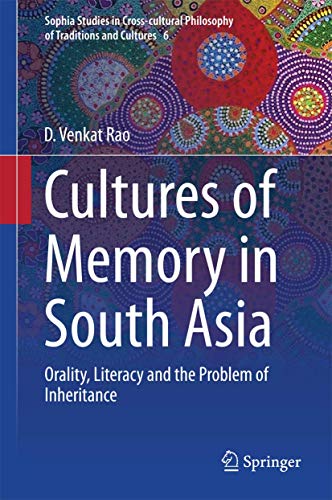
Cultures of memory in south asia : orality, literacy and the problem of inheritance / D Venkat Rao
Material type: TextPublisher number: :International Book Distributors | :Flat No 14, Prakash Apartment 5 Ansari Road Darya Ganj New DelhiSeries: Sophia studies in cross-cultural philosophy of traditions and cultures, v. 6Publication details: New Delhi : Springer, 2014.Description: xvi, 336 pages 24cmISBN:
- 9788132216971
- 181.4 RAO
| Item type | Current library | Call number | Status | Barcode | |
|---|---|---|---|---|---|
 Books |
SNU LIBRARY | 181.4 RAO (Browse shelf(Opens below)) | Not For Loan | 26506 |
Chapter 1. Introduction: Through the Postcolonial Abyss --
Part I: Signatures of Memory --
Chapter 2. Configurations of Memory and the Work of Difference --
Chapter 3. Futures of the Past: Mnemocultures and the Question of Inheritance --
Part II: Mnemotexts of Reflection --
Chapter 4. Learning in the Double Bind: Mnemotextual Inquiries and Action Knowledge --
Chapter 5. Fables of Identity and Contingencies of Certainty: Disarticulations of the Panchatantra --
Chapter 6. Tanunapat: Kalos, Philos and the Vestiges of Trace --
Part III: Embodiments of Response --
Chapter 7. The Mahabharata Contretemps: Temporality, Finitude and the Modes of Being in the Itihasa --
Chapter 8. Responsive Receptions: The Question of Translation beyond the Accursed Zone --
Chapter 9. Listening to the Text looms of Vemana: Memory, History and the Archives of Betrayal --
Chapter 10. Close Ups: Approaching Critical Humanities.
Cultures of Memory in South Asia reconfigures European representations of India as a paradigmatic extension of a classical reading, which posits the relation between text and context in a determined way. It explores the South Asian cultural response to European textual inheritances. The main argument of this work is that the reflective and generative nodes of Indian cultural formations are located in the configurations of memory, the body and idiom (verbal and visual), where the body or the body complex becomes the performative effect and medium of articulated memories. This work advances its arguments by engaging with mnemocultures cultures of memory that survive and proliferate in speech and gesture. Drawing on Sanskrit and Telugu reflective sources, this work emphasizes the need to engage with cultural memory and the compositional modes of Indian reflective traditions. This important and original work focuses on the ruptured and stigmatized resources of heterogeneous Indian traditions and calls for critical humanities that move beyond the colonially configured received traditions. Cultures of Memory suggests the possibilities of transcultural critical humanities research and teaching initiatives from the Indian context in today's academy
There are no comments on this title.
