
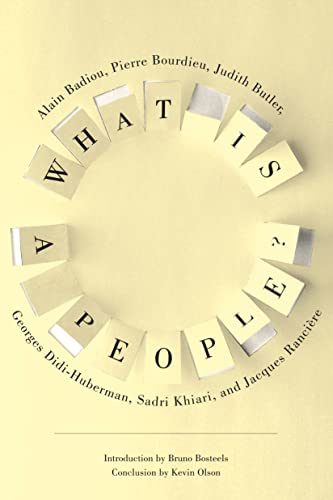
Amazon cover image
Image from Amazon.com
Image from Google Jackets

What is a people? /Alain Badiou et.all

By: Contributor(s): Material type: TextTextPublisher number: Atlantic Publishers & Distributors (P) Ltd. | ;7/22, Ansari Road, Darya Ganj, New Delhi-110002Publication details: New York : Columbia University Press , 2016.Description: vii,164 Pages ;20 cmISBN:
  • 9780231168762
Subject(s): Genre/Form: DDC classification:
  • 320.5662 BAD
Contents:
Introduction : This People Which Is Not One / Bruno Bosteels -- Twenty-Four Notes on the Uses of the Word "People" / Alain Badiou -- You Said "Popular"? / Pierre Bourdieu -- "We, the People" : Thoughts on Freedom of Assembly / Judith Butler -- To Render Sensible / Georges Didi-Huberman -- The People and the Third People / Sadri Khiari -- The Populism That Is Not to Be Found / Jacques Ranciere -- Conclusion : Fragile Collectivities, Imagined Sovereignties / Kevin Olson.
Summary: These outspoken intellectuals seek to reclaim "people" as an effective political concept by revisiting its uses and abuses over time. Alain Badiou surveys the idea of a people as a productive force of solidarity and emancipation and a negative tool of categorization and suppression. Pierre Bourdieu follows with a sociolinguistic analysis of "popular" and its transformation of democracy, beliefs, songs, and even soups into phenomena with outsized importance. Judith Butler calls out those who use freedom of assembly to create an exclusionary "we." Georges Didi-Huberman addresses the problem of summing up a people with totalizing narratives. Sadri Khiari applies an activist's perspective to the racial hierarchies inherent in ethnic and national categories, and Jacques RanciEre comments on the futility of isolating theories of populism when, as these thinkers have shown, the idea of a "people" is too diffuse to support them. By engaging this topic linguistically, ethnically, culturally, and ontologically, these scholars help separate "people" from its fraught associations to pursue more vital formulations.
Tags from this library: No tags from this library for this title. Log in to add tags.
Star ratings
    Average rating: 0.0 (0 votes)
No physical items for this record

Introduction : This People Which Is Not One / Bruno Bosteels --
Twenty-Four Notes on the Uses of the Word "People" / Alain Badiou --
You Said "Popular"? / Pierre Bourdieu --
"We, the People" : Thoughts on Freedom of Assembly / Judith Butler --
To Render Sensible / Georges Didi-Huberman --
The People and the Third People / Sadri Khiari --
The Populism That Is Not to Be Found / Jacques Ranciere --
Conclusion : Fragile Collectivities, Imagined Sovereignties / Kevin Olson.

These outspoken intellectuals seek to reclaim "people" as an effective political concept by revisiting its uses and abuses over time. Alain Badiou surveys the idea of a people as a productive force of solidarity and emancipation and a negative tool of categorization and suppression. Pierre Bourdieu follows with a sociolinguistic analysis of "popular" and its transformation of democracy, beliefs, songs, and even soups into phenomena with outsized importance. Judith Butler calls out those who use freedom of assembly to create an exclusionary "we." Georges Didi-Huberman addresses the problem of summing up a people with totalizing narratives. Sadri Khiari applies an activist's perspective to the racial hierarchies inherent in ethnic and national categories, and Jacques RanciEre comments on the futility of isolating theories of populism when, as these thinkers have shown, the idea of a "people" is too diffuse to support them. By engaging this topic linguistically, ethnically, culturally, and ontologically, these scholars help separate "people" from its fraught associations to pursue more vital formulations.

There are no comments on this title.

to post a comment.
Share

© Copyright Shiv Nadar University 2012. All Rights Reserved.  Disclaimer |  Sitemap
The Shiv Nadar University has been established under U.P. Act No 12 of 2011. Shiv Nadar University is UGC Approved.