
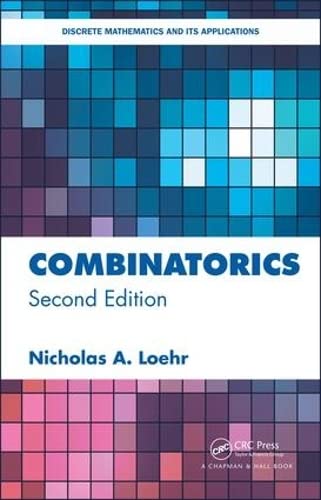
Combinatorics / Nicholas A. Loehr
Material type: TextPublisher number: :Zafaa Books & Distributors | :313/56F 49A, Anand Nagar Inderlok Delhi 110035Series: Discrete mathematics and its applicationsPublication details: Boca Raton : CRC Press, ©2018Edition: 2nd EdDescription: xxiv, 618p. illustrations :27 cmISBN:
- 9781498780254
- 511.62 LOE 23
| Item type | Current library | Call number | Status | Date due | Barcode | |
|---|---|---|---|---|---|---|
 Mathematics Departmental Library |
SNU LIBRARY | 511.62 LOE (Browse shelf(Opens below)) | Checked out to Dr. Neha Gupta (20500087) | 01/09/2023 00:00 | M387 |
Basic counting --
Combinatorial identities and recursions --
Counting problems in graph theory --
Inclusion-exclusion, involutions, and Möbius inversion --
Generating functions --
Ranking, unranking, and successor algorithms --
Groups, permutations, and group actions --
Permutation statistics and q-analogues --
Tableaux and symmetric polynomials --
Abaci and antisymmetric polynomials --
Algebraic aspects of generating functions --
Additional topics.
Combinatorics, Second Edition is a well-rounded, general introduction to the subjects of enumerative, bijective, and algebraic combinatorics. The textbook emphasizes bijective proofs, which provide elegant solutions to counting problems by setting up one-to-one correspondences between two sets of combinatorial objects. The author has written the textbook to be accessible to readers without any prior background in abstract algebra or combinatorics. Part I of the second edition develops an array of mathematical tools to solve counting problems: basic counting rules, recursions, inclusion-exclusion techniques, generating functions, bijective proofs, and linear algebraic methods. These tools are used to analyze combinatorial structures such as words, permutations, subsets, functions, graphs, trees, lattice paths, and much more. Part II cover topics in algebraic combinatorics including group actions, permutation statistics, symmetric functions, and tableau combinatorics. This edition provides greater coverage of the use of ordinary and exponential generating functions as a problem-solving tool. Along with two new chapters, several new sections, and improved exposition throughout, the textbook is brimming with many examples and exercises of various levels of difficulty."--Provided by publisher.
There are no comments on this title.
