
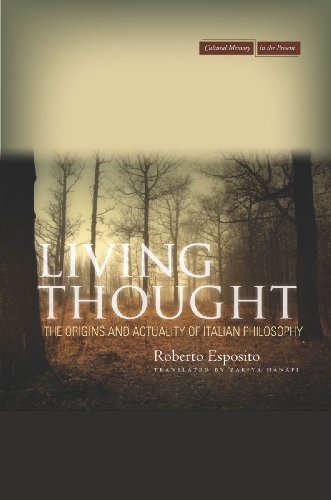
Living Thought : The Origins and Actuality of Italian Philosophy. /Roberto Esposito.
Material type: TextPublisher number: : International Book Distributors | : Flat no. 17, Prakash Apartment, Ansari Road, New DelhiPublication details: , California : Stanford University Press , 2012.Description: viii, 277p. : 24cmISBN:
- 9780804781565
- 195 ESP
| Item type | Current library | Call number | Status | Barcode | |
|---|---|---|---|---|---|
 Books |
SNU LIBRARY | 195 ESP (Browse shelf(Opens below)) | Available | 31275 |
The work of contemporary Italian thinkers, what Roberto Esposito refers to as Italian Theory, is attracting increasing attention around the world. This book explores the reasons for its growing popularity, its distinguishing traits, and why people are turning to these authors for answers to real-world issues and problems. The approach he takes, in line with the keen historical consciousness of Italian thinkers themselves, is a historical one. He offers insights into the great "unphilosophical" philosophers of life—poets, painters, politicians and revolutionaries, film-makers and literary critics—who have made Italian thought, from its beginnings, an "impure" thought. People like Machiavelli, Croce, Gentile, and Gramsci were all compelled to fulfill important political roles in the societies of their times. No wonder they felt that the abstract vocabulary and concepts of pure philosophy were inadequate to express themselves. Similarly, artists such as Dante, Leonardo Da Vinci, Leopardi, or Pasolini all had to turn to other disciplines outside philosophy in order to discuss and grapple with the messy, constantly changing realities of their lives.
There are no comments on this title.
