
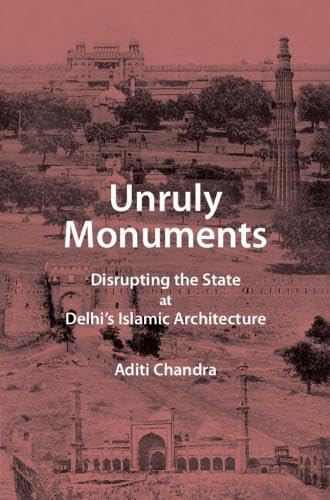
Unruly Monuments : Disrupting the state at Delhi's Islamic Architecture. / Aditi Chandra.
Material type: TextPublisher number: : Savera Book Distributors | : 4754 Akarshan Bhawan, 23 Ansari Road, Darya Ganj, New delhiPublication details: , New Delhi : Cambridge University Press , 2025.Description: xxii, 394p. : 24cmISBN:
- 9781009345170
- 954.56 CHA
| Item type | Current library | Call number | Status | Barcode | |
|---|---|---|---|---|---|
 Books |
SNU LIBRARY | 954.56 CHA (Browse shelf(Opens below)) | Not For Loan | 31420 |
It examines how Delhi's Sultanate and Mughal architecture, dating from the twelfth to the seventeenth centuries, became modern monuments and were assimilated and ordered into public consciousness as spaces for tourism, leisure, and intellectual contemplation during the colonial and early postcolonial eras (1828–1963). It examines the resistance that challenges this ordering, rendering monuments unruly and unassimilable despite state efforts to control their narrative. This exposes the nation's contradictory claims of inclusivity while marginalizing subaltern groups. It guides readers through picturesque landscapes, museums, imperial displays, postcards, travel experiences, Partition refugee camps, and cinema. Analyzing these forms reveals how the archive of Indo-Islamic monuments was shaped through presences and absences. Each chapter examines everyday life, untangles knowable public transcripts, illuminates strategic excisions and hidden transcripts, juxtaposes evidence that has not yet been analyzed in conjunction, reads archival material against the grain, and finds archival layers in unfamiliar places.
There are no comments on this title.
