
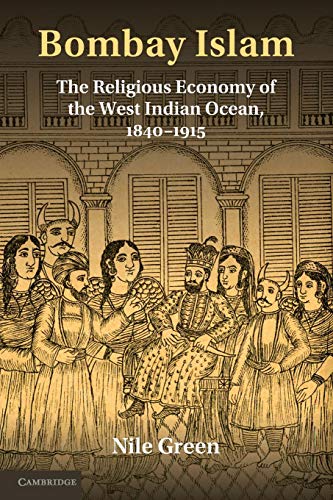
Bombay Islam : The religious economy of the West Indian Ocean, 1840-1915. / Nile Green.
Material type: TextPublisher number: : Raghav Books Pvt. Ltd. | : 2/25, First Floor, Arun House, Ansari Road, Darya Ganj, New DelhiPublication details: New York : Cambridge University Press; , 2013.Description: xvi;327p. : 24cmISBN:
- 9781107627796
- 330.954 GRE
| Item type | Current library | Call number | Status | Date due | Barcode | |
|---|---|---|---|---|---|---|
 Books |
SNU LIBRARY | 330.954 GRE (Browse shelf(Opens below)) | Checked out to MD TANWEER RAZA (2310120159) | 12/11/2026 00:00 | 31604 |
As a thriving port city, nineteenth-century Bombay attracted migrants from across India and beyond. Nile Green's Bombay Islam traces the ties between industrialization, imperialism and the production of religion to show how Muslim migration fueled demand for a wide range of religious suppliers, as Christian missionaries competed with Muslim religious entrepreneurs for a stake in the new market. Enabled by a colonial policy of non-intervention in religious affairs, and powered by steam travel and vernacular printing, Bombay's Islamic productions were exported as far as South Africa and Iran. Connecting histories of religion, labour and globalization, the book examines the role of ordinary people - mill hands and merchants - in shaping the demand that drove the market. By drawing on hagiographies, travelogues, doctrinal works, and poems in Persian, Urdu and Arabic, Bombay Islam unravels a vernacular modernity that saw people from across the Indian Ocean drawn into Bombay's industrial economy of enchantment.
There are no comments on this title.
