
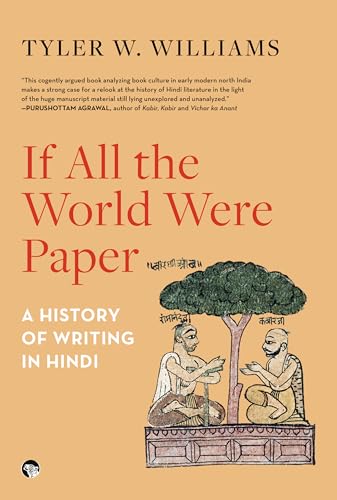
If All The World Were Paper : A History Of Writing In Hindi. / Tyler W. Williams.
Material type: TextPublisher number: : Technical Bureau India Pvt. Ltd. | : 4794/23, 1st Floor, Ansari Road, Daryaganj, New DelhiPublication details: , New Delhi : Speaking Tiger , 2024.Description: xxi, 307p. : 26cmISBN:
- 9789363360938
- 491.439 WIL
| Item type | Current library | Call number | Status | Date due | Barcode | |
|---|---|---|---|---|---|---|
 Books |
SNU LIBRARY | 491.439 WIL (Browse shelf(Opens below)) | Checked out to Chhavi Jain (20502252) | 13/12/2026 00:00 | 31809 |
Browsing SNU LIBRARY shelves Close shelf browser (Hides shelf browser)
| No cover image available No cover image available |

|
|

|
No cover image available No cover image available | No cover image available No cover image available |

|
||
| 491.438 IND A basic grammar of modern Hindi | 491.439 SAL Diwan-e-Ghalib | 491.439 SAL Diwan E Ghalib. | 491.439 WIL If All The World Were Paper : A History Of Writing In Hindi. | 491.44 BEN An advanced course in Bengali | 491.44 SEN Learn Bengali in 30 days. | 491.442 SAR Shabda cayanika |
"How do writing and literacy reshape the ways a language and its literature are imagined? Combining close readings of literary and scholarly works with the study of hundreds of handwritten books from the precolonial era, If All the World Were Paper explores this question in the context of Hindi, the most widely spoken language in India and the fourth most widely spoken language in the world today. The material and social processes through which Hindi came to be written down, and the particular forms these texts took—from illustrated storybooks of Sufi romances to loose-leaf textbooks used by Bhakti singers; from personal notebooks to cloth-wrapped scriptures—played a critical role in establishing it as a language capable of transmitting poetry, erudition, and even revelation. Emerging onto the literary scene of the subcontinent in the mid-fourteenth century, through humble and ornate literary objects alike, the vernacular of Hindi quickly came to acquire a place alongside ‘classical’ languages like Sanskrit and Persian as a medium of literature and scholarship, shaping its growth for centuries to come. Demonstrating how the life of books—the way they were inscribed, organized, and handled—can tell us as much about their meaning and significance as the words within, Tyler W. Williams forcefully argues for a new approach to the history of languages. This book is both a history of Hindi’s literary formation and an urgent call to engage differently with the fragile multilingual archives of South Asia, before time and neglect erase them."
There are no comments on this title.
