
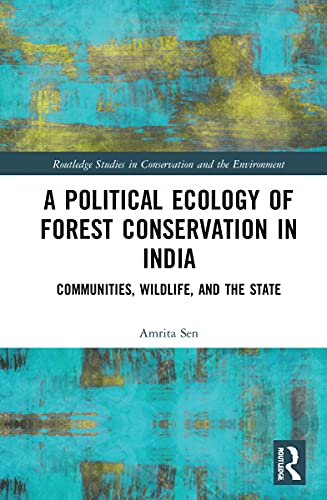
A Political Ecology of Forest Conservation In India : Communities, Wildlife and the State. / Amrit Sen
Material type: TextPublisher number: : Feel Books Pvt. Ltd. | : 4381/4, Ansari Road, Daryaganj, New Delhi-110002Publication details: New York : Routledge. , 2022Description: xiv, 202p. : 24cmISBN:
- 9781032116396
- 333.750 SEN
| Item type | Current library | Call number | Status | Barcode | |
|---|---|---|---|---|---|
 Books |
SNU LIBRARY | 333.750 SEN (Browse shelf(Opens below)) | Not For Loan | 31876 |
This book critically explores the political ecology of human marginalization, wildlife conservation and the role of the state in politicizing conservation frameworks, drawing on examples from forests in India. The book specifically demonstrates the nuances within human-environmental linkages, by showing how environmental concerns are not only ecological in content but also political. In India a large part of the forests and their surrounding areas were inhabited far before they were designated as protected areas and inviolate zones, with the local population reliant on forests for their survival and livelihoods. Thus, socioecological conflicts between the forest dependents and official state bodies have been widespread. This book uses a political ecology lens to explore the complex interplay between current norms of forest conservation and environmental subjectivities, illustrating contemporary articulation of forest rights and the complex mediations between forest dependents and different state and non-state bodies in designing and implementing regulatory standards for wildlife and forest protection. It foregrounds the issues of identity, migration and cultural politics while discussing the politics of conservation. Through a political ecology approach, the book not only is human-centric but also makes significant use of the role of non-humans in foregrounding the conservation discourse, with a particular focus on tigers. The book will be of great interest to students and academics studying forest conservation, human–wildlife interactions and political ecology.
There are no comments on this title.
