
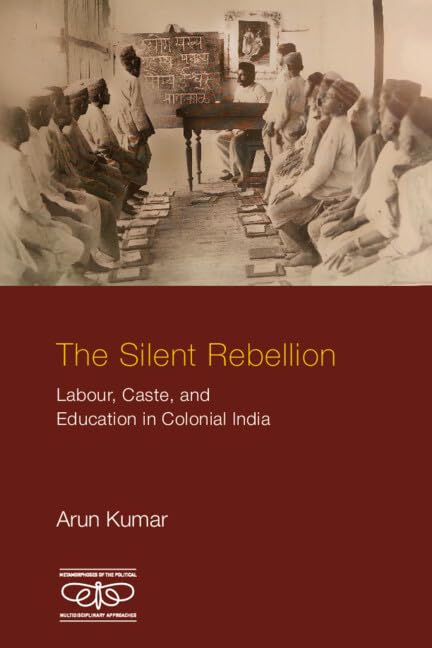
The Silent Rebellion : Labour, Caste, and Education in Colonial India. / Arun Kumar.
Material type: TextPublisher number: : Technical Bureau India Pvt. Ltd. | : 4794/23, Ansari Road, Daryaganj, New DelhiPublication details: , New Delhi : Cambridge University Press , 2026.Description: xx, 307p. : 24cmISBN:
- 9781009885522
- 370.1150954 KUM
| Item type | Current library | Call number | Status | Barcode | |
|---|---|---|---|---|---|
 Books |
SNU LIBRARY | 370.1150954 KUM (Browse shelf(Opens below)) | Not For Loan | 31933 |
The Silent Rebellion tells a history of labour subjectivity formation at the site of education and the defiance of labouring subalterns who refused to see themselves solely as labouring bodies in the late nineteenth and twentieth centuries. It does so by focusing on the hitherto neglected social histories of nonelite education: industrial, technical, factory, and night schools. On the one hand, the book examines how elites-encompassing colonial officials, employers, and dominant castes-integrated caste labour into their modern projects of industrial and technical education, thereby reproducing labouring conditions, subjectivities, and the caste social order. On the other hand, the book reveals how labouring subalterns-artisans, factory workers, and service-industry workers-used education to rebel against their 'pre-destined' labouring fate. Focusing on their demands for literary education, experiences of reading, and becoming teachers, clerks, and poets, the book develops new analytical frameworks for writing nonwork histories of working lives.
There are no comments on this title.
