
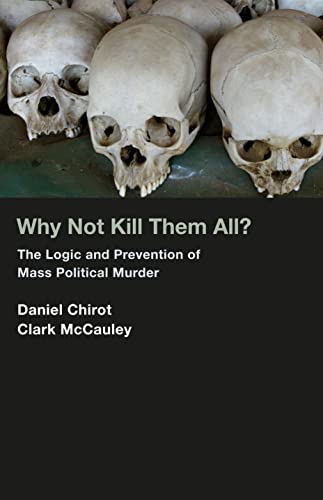
Why not kill them all? : the logic and prevention of mass political murder. / Daniel Chirot.
Material type: TextPublisher number: : Zafaa Books & Distributors | : 313/56F,49A, Anand Nagar, Inderlok, Delhi.Publication details: , Princeton : Princeton University Press , 2010.Description: xiv, 268 pages :24cmISBN:
- 9780691145945
- 304.663 CHI
| Item type | Current library | Call number | Status | Barcode | |
|---|---|---|---|---|---|
 Books |
SNU LIBRARY | 304.663 CHI (Browse shelf(Opens below)) | Not For Loan | 29297 |
Introduction. Are we killers or peacemakers?
1. Why genocides? : are they different now than in the past?
The four main motives leading to mass political murder
Are modern genocides and ethnic cleansings different?
Retribalization and the modern state
2. The psychological foundations of genocidal killing
How to get ordinary people to become butchers
Organization
Emotional appeals : leaders and followers
Essentializing others
The dangerous similar others
The conditions of genocide
3. Why is limited warfare more common than genocide?
Weighing the costs of genocidal conflicts
Limiting the damage of warfare
Exogamy : making the enemy part of the family
Establishing codes of warfare and exchange to limit violence
Are rules of exogamy, codes of honor, and potlatching still relevant?
The mercantile compulsion
Morality and modesty : rejecting certitude
Yearning for solutions
4. Strategies to decrease the chances of mass political murder in our time
State policies that reduce hostility between groups
Limiting demands for justice and revenge
Modest solutions and small-scale changes to promote tolerance
The crucial role of states in promoting peaceful exchanges
Individual rights and pluralist histories
Conclusion. Our question answered
Cowritten by historical sociologist Daniel Chirot and psychologist Clark McCauley, the book goes beyond exploring the motives that have provided the psychological underpinnings for genocidal killings. It offers a historical and comparative context that adds up to a causal taxonomy of genocidal events. Rather than suggesting that such horrors are the product of abnormal or criminal minds, the authors emphasize the normality of these horrors: killing by category has occurred on every continent and in every century. But genocide is much less common than the imbalance of power that makes it possible. Throughout history human societies have developed techniques aimed at limiting intergroup violence. Incorporating ethnographic, historical, and current political evidence, this book examines the mechanisms of constraint that human societies have employed to temper partisan passions and reduce carnage."
There are no comments on this title.
