
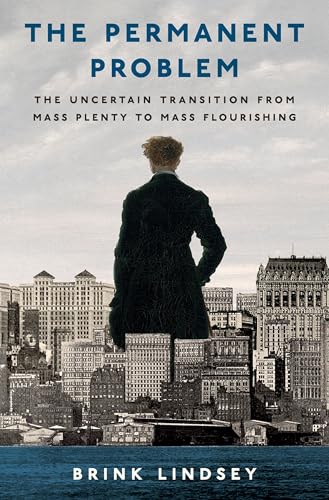
The Permanent Problem : The Uncertain Transition from Mass Plenty to Mass Flourishing. / Brink Lindsey.
Material type: TextPublisher number: : Raghav Books Pvt. Ltd | : 2/25, First Floor, Arun House, Ansari Road, Darya Ganj, New DelhiPublication details: , New York : Oxford University Press , 2026.Description: vii, 234p. : 24cmISBN:
- 9780197803967
- 330.1 LIN
| Item type | Current library | Call number | Status | Barcode | |
|---|---|---|---|---|---|
 Books |
SNU LIBRARY | 330.1 LIN (Browse shelf(Opens below)) | Available | 31541 |
In The Permanent Problem, Brink Lindsey reshapes our understanding of the vital but complex relationship between material prosperity and human flourishing. The advanced capitalist democracies of the 21st century are the richest, freest, healthiest, best educated, and best governed societies in history. Why then does it seem like everything is falling apart? Economic stagnation is spreading, class divisions are deepening, birth rates are collapsing, mental health problems are on the rise, faith in democracy is in decline, and pessimism about the future abounds.In The Permanent Problem, Brink Lindsey argues that these gathering difficulties reflect the stresses and strains of a great and uncompleted historical transition-from mass material prosperity to mass human flourishing. Capitalism's immense productive powers have raised our expectations of what life can be, but for most of us reality is coming up short. What's more, the arrival of mass prosperity has pushed both economic and cultural change in directions that make the transition to mass flourishing much harder to achieve.According to Lindsey, 21st century capitalism is in the grip of three interrelated crises: a crisis of inclusion, as vital social ties and personal connections are breaking down; a crisis of dynamism, as capitalism's engines of innovation and wealth creation have begun to sputter and seize; and a crisis of politics, as the mechanisms for collective decision-making needed to address capitalism's growing problems have been degraded by the very same dynamics that underlie those problems.A much brighter future is possible, and Lindsey charts an intriguing path to get there. There is no need to concoct a radical new social system. Instead, capitalism needs to be refocused on its core mission of extending the technological frontier, and rebalanced through the revitalization of face-to-face communities. Weaving together insights from history, economics, sociology, and philosophy, The Permanent Problem offers a synoptic overview of our fateful present moment and a provocative glimpse at what may lie ahead.
There are no comments on this title.
