
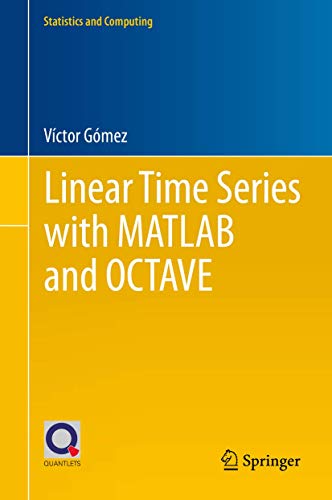
Linear time series with Matlab and octave / Víctor Gómez
Material type: TextPublisher number: :International Book Distributors | :Flat No 14, Prakash Apartment 5 Ansari Road Darya Ganj New DelhiSeries: Statistics and computingPublication details: Cham : Springer, 2019Description: xvii, 339 pages 24cmISBN:
- 9783030207892
- 519.55 GOM
| Item type | Current library | Call number | Status | Barcode | |
|---|---|---|---|---|---|
 Books |
SNU LIBRARY | 519.55 GOM (Browse shelf(Opens below)) | Not For Loan | 27347 |
Intro; Preface; Software Installation; References; Contents; 1 Quick Introduction to SSMMATLAB; 1.1 ARIMA Models; 1.2 Transfer Function Models; 1.3 Univariate Structural Models; 1.4 VARMA and VARMAX Models; 1.5 Innovations State Space Models and Likelihood Evaluation; Reference; 2 Stationarity, VARMA, and ARIMA Models; 2.1 Stationarity and VARMA Models; 2.1.1 Simulation of VARMA Models; 2.1.2 Sample Autocorrelations and PartialAutocorrelations; 2.1.3 VAR Models; 2.1.4 VAR Least Squares Estimation and Identification 2.1.5 Multiplicative VARMA Models: Preliminary Estimation and Model Simplification2.1.6 Multiplicative VARMA Model Identification; 2.1.7 Innovations State Space Models; 2.1.8 Fixing of Parameters; 2.1.9 Model Estimation Using the Kalman Filter; 2.1.10 Missing Observations; 2.1.11 Recursive Residuals and OLS Residuals; 2.1.12 Forecasting; 2.1.13 VARMA Models in Echelon Form; 2.1.14 VARMA Models in State Space Echelon Form; 2.1.15 Identification and Estimation of VARMA Models in Echelon Form; 2.2 ARMA and ARIMA Models; 2.2.1 State Space Form; 2.2.2 Complex Seasonal Patterns 2.2.3 Model Identification2.2.4 Model Estimation; 2.2.5 Fixing of Parameters; 2.2.6 Simplified ARIMA Estimation; 2.2.7 Missing Values; 2.2.8 Residuals; 2.2.9 Residual Diagnostics; 2.2.10 Tests for Residual Seasonality; 2.2.11 ARIMA Forecasting; 2.2.12 Forecasting Transformed Variables; 2.2.13 Trading Day, Easter, and Leap Year Effects; 2.2.14 Automatic Outlier Detection; 2.2.15 Automatic ARIMA Model Identification and Estimation; 2.2.16 Simplified Automatic ARIMA Specification and Estimation; References; 3 VARMAX and Transfer Function Models; 3.1 VARMAX Models 3.1.1 State Space Models With Inputs3.1.2 VARX Models; 3.1.3 VARX Identification and Least SquaresEstimation; 3.1.4 Identification and Estimation of VARMAX(p, q, r) Models; 3.1.5 VARMAX Models in Echelon Form; 3.1.6 VARMAX Models in State Space Echelon Form; 3.1.7 Identification and Estimation of VARMAX Models in Echelon Form; 3.1.8 VARMAX Estimation Using Regression Techniques: The Hannan-Rissanen Method; 3.1.9 Model Simplification Using Stepwise Regression; 3.1.10 The Conditional Method for VARMAXEstimation; 3.1.11 The Exact ML Method for VARMAX Estimation; 3.1.12 Forecasting VARMAX Models 3.2 Transfer Function Models3.2.1 TF Model Specification and Estimation; 3.2.2 TF Model Identification; 3.2.3 Automatic TF Model Identificationand Estimation; 3.2.4 Missing Values; 3.2.5 Residual Diagnostics, Forecasting, and Outliers; 3.2.6 Simplified Automatic TF Identification and Estimation; References; 4 Unobserved Components in Univariate Series; 4.1 Structural Models; 4.1.1 Model Specification and Estimation; 4.1.2 Simplified Model Specification and Estimation; 4.1.3 Model Identification; 4.1.4 Missing Values; 4.1.5 Residual Diagnostics and Forecasting; 4.1.6 Smoothing
This book presents an introduction to linear univariate and multivariate time series analysis, providing brief theoretical insights into each topic, and from the beginning illustrating the theory with software examples. As such, it quickly introduces readers to the peculiarities of each subject from both theoretical and the practical points of view. It also includes numerous examples and real-world applications that demonstrate how to handle different types of time series data. The associated software package, SSMMATLAB, is written in MATLAB and also runs on the free OCTAVE platform. The book focuses on linear time series models using a state space approach, with the Kalman filter and smoother as the main tools for model estimation, prediction and signal extraction. A chapter on state space models describes these tools and provides examples of their use with general state space models. Other topics discussed in the book include ARIMA; and transfer function and structural models; as well as signal extraction using the canonical decomposition in the univariate case, and VAR, VARMA, cointegrated VARMA, VARX, VARMAX, and multivariate structural models in the multivariate case. It also addresses spectral analysis, the use of fixed filters in a model-based approach, and automatic model identification procedures for ARIMA and transfer function models in the presence of outliers, interventions, complex seasonal patterns and other effects like Easter, trading day, etc. This book is intended for both students and researchers in various fields dealing with time series. The software provides numerous automatic procedures to handle common practical situations, but at the same time, readers with programming skills can write their own programs to deal with specific problems. Although the theoretical introduction to each topic is kept to a minimum, readers can consult the companion book 'Multivariate Time Series With Linear State Space Structure', by the same author, if they require more details
There are no comments on this title.
