
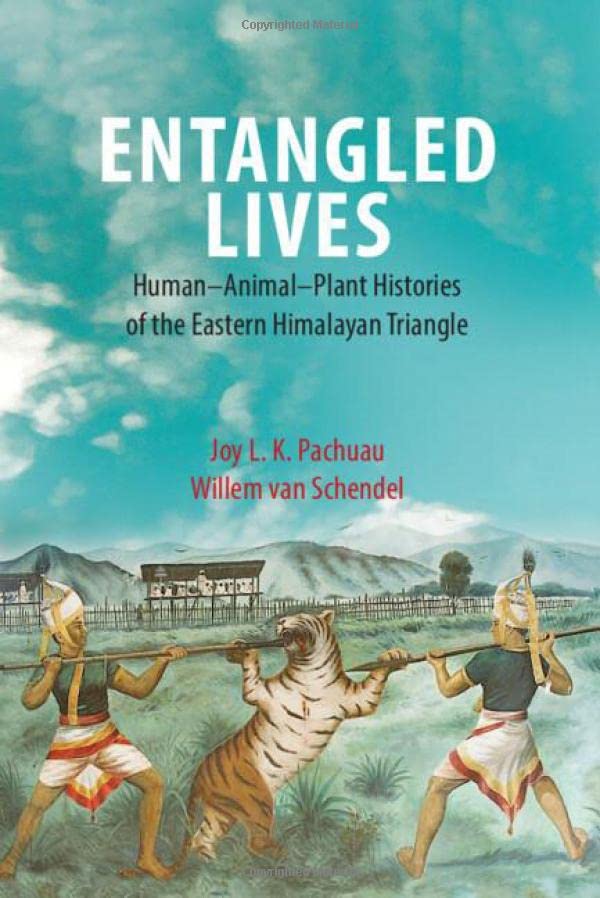
Entangled lives : human-animal-plant histories of the Eastern Himalayan triangle /Joy Pachuau.
Material type: TextPublisher number: : Raghav Books Pvt. Ltd. | ; A-184, A, Nand Gram, Ghaziabad,U.P.Publication details: , Cambridge, United Kingdom : Cambridge University Press , 2022.Description: xi, 363 pages : illustrations, maps ; 24 cmISBN:
- 9781009215473
- 304.209 PAC
| Item type | Current library | Call number | Status | Barcode | |
|---|---|---|---|---|---|
 Books |
SNU LIBRARY | 304.209 PAC (Browse shelf(Opens below)) | Available | 29330 |
List of Maps; List of Plates; Acknowledgements; Introduction; Part I. The Deep Past: 1. An Epic Crash; 2. Human Beginnings; 3. Changing the Environment; 4. Livelihoods; Part II. Cosmologies: 5. Stories of Human Origins; 6. Human-animal Histories; 7. Human-plant Histories; Part III. More-Than-Human Histories: 8. Cultural geographies; 9. Exploiting Natural Resources; 10. Dealing with Environmental Decay; 11. The Elephant Strikes Back; Conclusion; Bibliography; Copyrights and Sources; Index.
"This book considers three questions about understanding the past. How can we rethink human histories by including animals and plants? How can we overcome nationally territorialised narratives? And how can we balance academic history-writing and indigenous understandings of history? This is a tentative foray into the connections between these questions. The authors explore them for a large area that historians seldom choose as their unit of inquiry. The "Eastern Himalayan Triangle" (elaborated further in the abstract that follows) includes both uplands and lowlands and is the meeting point of three global biodiversity hotspots, and connects India and China across Myanmar, Bangladesh and Bhutan. They treat the "Triangle" as a multispecies site in which human histories have always been utterly intertwined with plant and animal histories. The main objective is to foreground that history is co-created - it is always interspecies history - but that its contours are locally specific. The book presents a wealth of environmental specificities in which human history is embedded. The multispecies complexities encountered require the authors to recalibrate the conventions of academic history-writing and they do so by advancing new spatial and temporal imaginations - pushing beyond both methodological nationalism and traditional periodisation - and carefully considering local life-worlds and multispecies cosmologies"
There are no comments on this title.
