
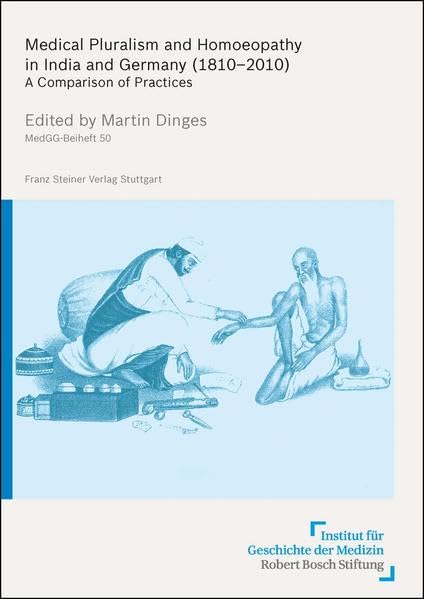
Medical pluralism and homoeopathy in India and Germany (1810-2010) : a comparison of practices /Martin Dinges.
Material type: TextPublisher number: : Zafaa Books & Distributor | : 313/56F, Anand Nagar, Inderlok, Delhi.Publication details: , Stuttgart : Franz Steiner Verlag , 2014.Description: 254 pages : 24cmISBN:
- 9783515104845
- 615.532 DIN
| Item type | Current library | Call number | Status | Barcode | |
|---|---|---|---|---|---|
 Books |
SNU LIBRARY | 615.532 DIN (Browse shelf(Opens below)) | Not For Loan | 28995 |
Martin Dinges
Introduction; Silvia Waisse
East Meets West: Johann M. Honigberger and Medical Pluralism through the Eyes of a 19th Century Transylvanian Saxon in India; Shinjini Das
Innovating Indigeneity, Reforming Domesticity: Nationalising Homeopathy in Colonial Bengal; Avi Sharma
Rethinking Asymmetries in the Marketplace: Medical Pluralism in Germany, 1869-1910; Ameeta R. Manchanda
A Homeopathic Clinic in a Multispeciality Hospital. Reflections from Practice. Raj Kumar Manchanda, Surender Kumar Verma, Leena V. Chhatre, Harleen Kaur
Homeopathy in Urban Primary Healthcare Units of the Delhi Government: An AssessmentHarish Naraindas
Nosopolitics. Epistemic Mangling and the Creolization of Contemporary Ayurveda; Hugues Dusausoit
The Quest for Another Recognition. Ethnography of an homeopath in Tamil Nadu; Marion Baschin
The Patients' Choice
How and Why Sick People Used Homeopathy in 19th Century Münster; Rahul Tewari, Ramachandran Valavan
Patients' Trend in Choosing the Homeopathic Medical System in India. Philipp Eisele
Medical Pluralism and the Patients' Perspective in Germany
Letters to "Natur und Medizin" (1992-2000)Nupur Barua
Medical Pluralism in a Slum in Delhi: Global Medicine in a Local Garb?; Krishna Soman
Pluralism, Popularity and Propaganda: Narratives of Lay Practices of Homeopathy in India; William Sax
Looking Behind and Ahead; Authors
Medical Pluralism is by now recognized as a reality in many countries. Studies, however, bringing together anthropologists and historians working on this subject are still rare. A comparative view on Germany and India with their different patterns of institutionalisation of medical pluralism is particularly rewarding. This volume focuses on practices starting with the story of a Transsylvanian lay healer who functioned in Lahore as a cultural broker. Indigenising of homoeopathy in Bengal shows a particular mode of appropriation.
There are no comments on this title.
